Porch Light Letters ·
How Far Back Can I Realistically Trace My Family Tree
Have you ever wondered whether your family tree could take you all the way back to the Middle Ages, or perhaps even further into ancient history? Maybe you've seen someone proudly displaying a family tree that stretches back hundreds or even thousands of years and wondered whether you could discover the same thing about your ancestors. The thought of uncovering generations of family history is exciting, but how far back can we realistically go before the historical records become scarce, unreliable, or disappear altogether? Could your family tree reveal ancestors from the 1500s, the 1200s, or even earlier, and how would you know whether those connections are actually correct?
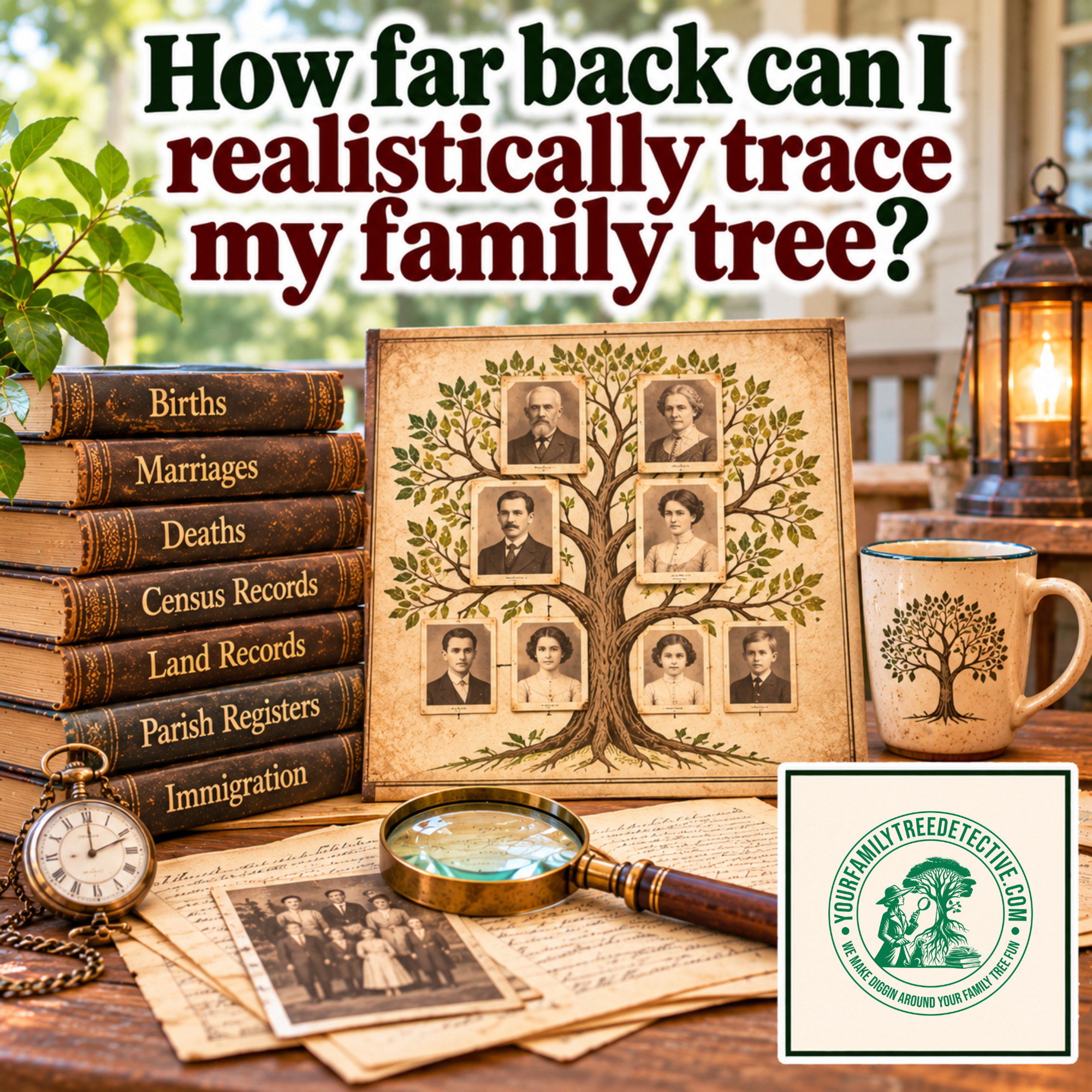
For many people researching ancestors in countries with well-preserved written records, tracing family lines back to the 1700s or 1800s is a realistic starting goal, while some branches may reach the 1500s or 1600s. The availability of birth, marriage, death, census, parish, land, probate, and other historical records plays a significant role in determining how far your research can go. In England and Wales, parish registers were ordered to begin in 1538, although many early registers have been lost, damaged, or contain gaps, while civil registration began in 1837. Other countries and communities have different recordkeeping traditions, meaning one branch of your family tree might stretch back several centuries while another becomes difficult to trace after only a few generations.
Your ancestors' circumstances can also influence how much information survives about their lives and families. Wealthy landowners, nobility, merchants, and people involved in government or religious institutions sometimes appear in records extending back many centuries because their property, titles, and activities were documented. Ordinary working families may be harder to trace, particularly when records were destroyed by fires, wars, natural disasters, or simply never created in the first place. Migration, changing surnames, language differences, adoption, enslavement, displacement, and inconsistent recordkeeping can introduce additional challenges, but these obstacles do not necessarily mean your research has reached a permanent dead end.
One of the biggest mistakes in genealogy is assuming that a family tree stretching back hundreds or thousands of years must be accurate simply because someone has published it online. Some online trees claim connections to medieval royalty, ancient civilisations, or famous historical figures, but these relationships may rely on undocumented assumptions, incorrect identities, or generations copied from other researchers without verification. DNA testing can provide valuable clues about genetic relatives and ancestral origins, but it cannot independently prove an unbroken family line back to a particular person who lived a thousand years ago. Reliable genealogy requires examining historical evidence, comparing sources, confirming relationships between generations, and recognising when the available information is insufficient to support a particular connection.
So, how far back can you realistically trace your family tree, and when should you consider your research complete? There is no universal answer because every family has a different history, and the records available for one ancestral line may be completely different from those available for another. Rather than measuring success by how many centuries you can travel backwards, focus on building a well-documented family tree that accurately represents the people, places, relationships, and experiences of your ancestors. Whether your research takes you back three generations or three hundred years, the real reward is discovering the stories behind the names and preserving those connections for the generations who come after you.
Today's Family Tree Challenge: Choose one branch of your family tree and identify the earliest ancestor you have documented with reliable historical evidence. Look at the records you already have and determine whether they provide enough information to identify that person's parents or an earlier generation. Search for one additional historical record, such as a birth, marriage, death, parish, land, or probate record, that might help extend your research further back. Record your findings, note any unanswered questions, and remember that a well-supported family connection is far more valuable than an impressive but unverified date.
Let us know in the comments below about the stories you uncover.
Podcast Replay: https://youtube.com/live/TwM81vEG8eY?feature=share
Ready to uncover your own family story?