Porch Light Letters ·
Where Was Your Family When… They Learned to Write Their Name
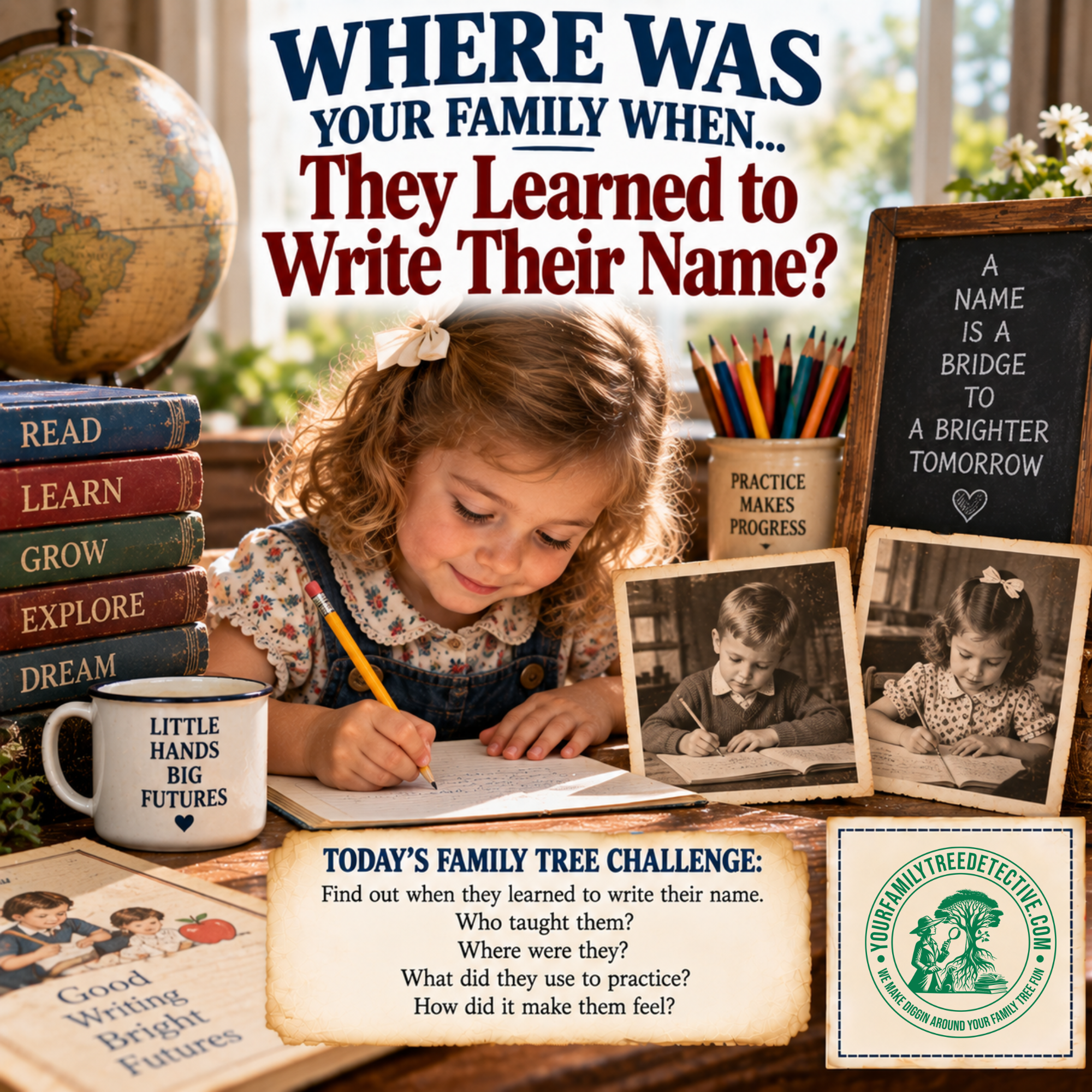
There is something special about the first time a child learns to write their own name. Those letters may be wobbly, backwards, different sizes, and scattered across the page, but they represent something important. For the first time, a child is learning to put their own identity into writing.
Do you know who taught your parents, grandparents, or great-grandparents to write their names? Perhaps it was a parent sitting beside them at the kitchen table, an older sibling showing them how to form each letter, or a teacher guiding their hand during their first days at school.
Think about what they used to practise. Today we might immediately reach for pencils and paper, but earlier generations could have learned using chalk and slate. They may have copied letters from a blackboard, traced them in a schoolbook, practised with a fountain pen and ink, or repeatedly written their name on scraps of paper until they finally got it right.
Their first attempts may even have survived. Look through old schoolbooks, childhood drawings, birthday cards, letters, autograph books, family Bibles, and other papers. Somewhere among them could be one of the earliest examples of a family member's handwriting.
Handwriting can become almost as recognisable as someone's face. You might instantly recognise your grandmother's handwriting on a recipe card or your father's writing on the back of an old photograph. Even decades after someone is gone, seeing their handwriting can bring back memories of them.
For our ancestors, being able to sign their own name could also represent something much bigger. Education wasn't available equally to everyone, and some children received very little formal schooling. Others left school early to work, help on the family farm, care for younger siblings, or contribute to the household.
Genealogists sometimes encounter ancestors who signed official documents with an "X" or another mark because they couldn't write their names. Marriage records, wills, deeds, military documents, immigration papers, and other records can provide clues about someone's ability to read and write. Rather than simply noting the mark, consider what it tells you about that person's life, education, opportunities, and circumstances.
Signatures can also help us follow someone through their lifetime. You might find the same ancestor's signature on a marriage certificate, military record, land document, passport application, or will. Seeing their actual handwriting creates a connection that a typed transcription simply cannot provide.
Names themselves can add another layer to the story. Did someone always use their full given name, or did they shorten it? Did they use a middle name instead of their first name? Did their spelling change over time? An ancestor who moved to another country may even have adapted how they wrote their name to fit a different language or culture.
Today's Family Tree Challenge: Find an example of a family member's handwriting or signature. Ask older relatives if they remember learning to write their names. Who taught them? Where were they? What did they use to practise? Do they remember being proud of finally getting every letter right? Then look through your family records to see whether you can find signatures from earlier generations.
Don't just preserve what your ancestors wrote. Preserve examples of how they wrote it. A signature may consist of only a few letters, but those letters were formed by the hand of someone whose life eventually became part of your own story.
Let us know in the comments below about the stories you uncover.
Podcast replay: https://youtube.com/live/zgMj0rnHFFM?feature=share
Ready to uncover your own family story?