
Porch Light Letters ·
Where Was Your Family When… They Returned to a Place From Their Childhood
There is something extraordinary about returning to a place that was once part of your everyday life. A house, a street, a school, a neighbourhood, or even a particular tree can suddenly unlock memories that have been tucked away for decades. Sometimes all it takes is standing in front of a familiar building to remember people, conversations, smells, sounds, and experiences you haven't thought about in years.
Have you ever returned to your childhood home? Perhaps you drove past the house where you grew up, walked along the street where you played with friends, or stood outside the school you attended. Did everything look exactly as you remembered, or had the years changed the place so much that you could barely recognise it?
Now take that experience a few generations further. Have you ever visited the homes where your parents, grandparents, or great-grandparents lived? Imagine standing outside a house where your grandmother spent her childhood, walking along the road your grandfather travelled to school, or discovering the cottage where your great-grandparents began their married life.
These visits can create an extraordinary connection with family history. Suddenly, the names and addresses you've been researching become real places. You can see the distance between the family home and the local school, church, shops, railway station, or workplace. You begin to understand the environment in which your ancestors lived and the community that helped shape their lives.
Start with your own childhood home. Do you remember the layout of the rooms? Where did everyone sit for meals? Which bedroom was yours? Was there a particular spot in the garden where you played? Perhaps you remember the kitchen where Mum cooked, Dad's workshop, the front porch, or a favourite tree that seemed enormous when you were little.
What about your parents' childhood homes? Did they grow up in the same town as you, or somewhere completely different? Perhaps they lived on a farm, in a small village, beside the sea, or in a busy city neighbourhood. Ask them to describe the house, the people who lived there, and what an ordinary day looked like when they were growing up.
Then explore your grandparents' homes. Were they living in a house that had already belonged to the family for generations? Did several generations share the same household? Was there electricity, indoor plumbing, a telephone, or central heating? How many children shared bedrooms? What did the family do for entertainment, and where did everyone gather in the evenings?
Going back another generation can reveal even more. Your great-grandparents may have lived in a house that no longer exists, on land that has since been subdivided, or in a neighbourhood transformed beyond recognition. Perhaps the original building is still standing, although its purpose has changed. An old family home might now be a shop, office, restaurant, or completely different residence.
Sometimes the most fascinating discoveries happen when you compare the past with the present. An old photograph may show a dirt road where there is now a busy street. A large family garden may have become another house. A railway line might have disappeared, or a once-thriving shopping district may have changed completely. Those differences tell us about the history of the community as well as the family.
Look for the places surrounding the home. Where did your ancestors buy their groceries? Which school did the children attend? Where did they work? Was there a favourite park, cinema, swimming hole, bakery, or meeting place? The family home was only one part of the world they knew.
If you are fortunate enough to visit with a parent, grandparent, aunt, uncle, or older relative, let them guide the journey. They may remember things that would never appear in an official record. Perhaps they can point to the window of their childhood bedroom, the spot where a family photograph was taken, or the house where their best friend lived.
Listen carefully to the stories that emerge. Someone may suddenly remember the neighbour who always gave children sweets, the tree they climbed, the shortcut they took to school, or the day something unforgettable happened on that very street. These are the details that turn a collection of addresses into a living family history.
Don't be discouraged if the original house is gone. The land itself still has a story. Standing where your ancestors once lived can be meaningful even if a modern building now occupies the site. Historical maps, property records, old photographs, directories, census records, electoral rolls, newspapers, and local archives may help you reconstruct what the location looked like during their lifetime.
Before visiting, gather as much information as possible. Find old addresses, photographs, maps, and descriptions of the properties. Check whether street names or house numbers have changed. If the building still exists, remember that it may now be someone's private home. You can appreciate its history while respecting the privacy of the people who live there today.
Take photographs of the places you visit. If you have an old family photograph showing the same location, try to capture a modern image from a similar position. Place the photographs side by side and compare what has changed and what remains. You may discover that a doorway, fence, tree, window, or other small feature has survived for generations.
Record your own reactions too. What did you feel when you stood outside the house? Did the place seem smaller than you remembered? Did it bring back happy memories, unexpected emotions, or questions you had never considered? Sometimes returning to a childhood place reveals as much about our own journey through life as it does about the building itself.
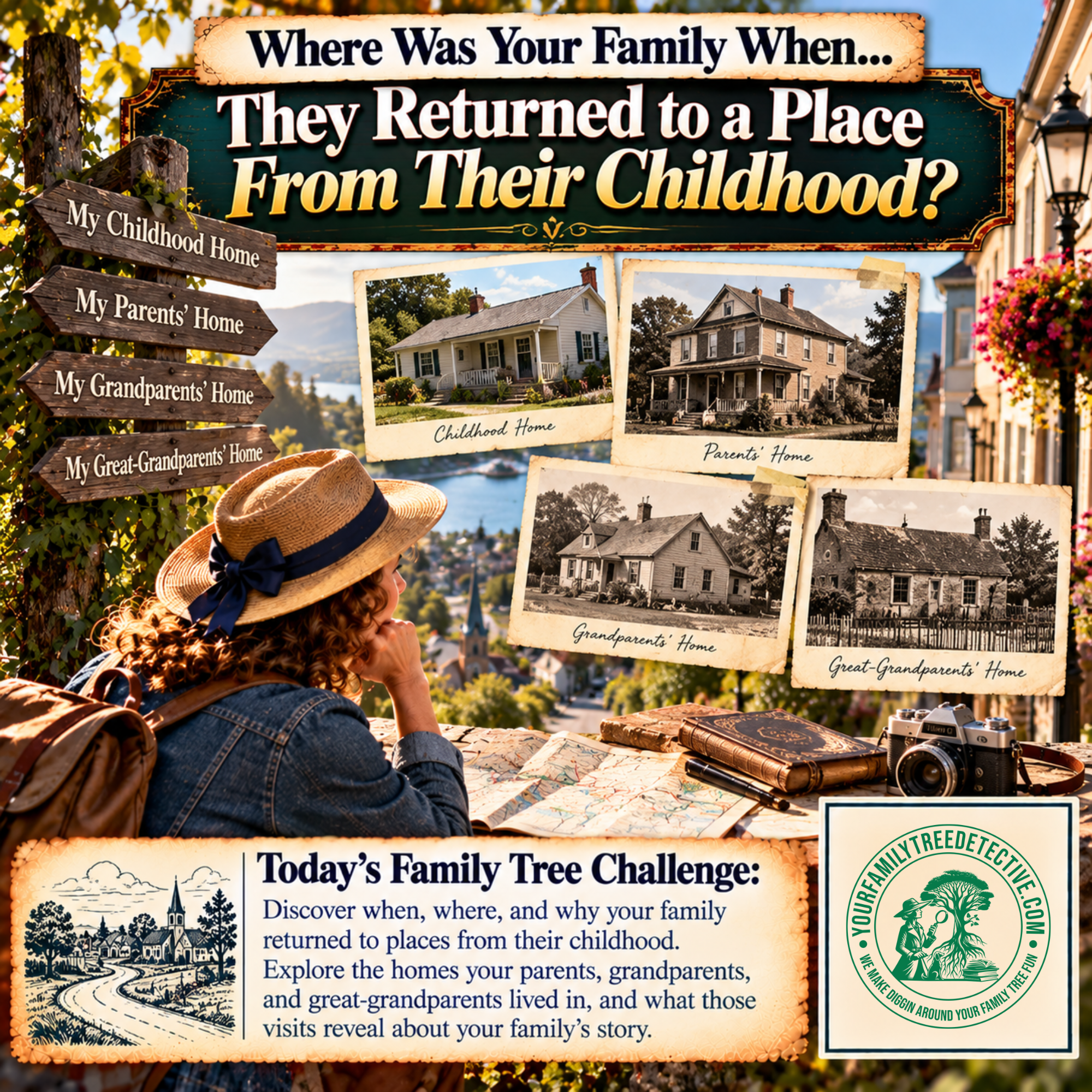
Today's Family Tree Challenge: Choose four places connected to your family history. Your childhood home, a home where one of your parents grew up, a grandparent's home, and a great-grandparent's home. Find their addresses, locate them on a map, and discover whether the buildings still exist. Search for old photographs and records that can help you understand what each place looked like when your family lived there.
If possible, visit those locations or explore them using historical photographs and maps. Talk with relatives who remember them. Ask who lived there, what the rooms were like, what the neighbourhood was like, and which memories are connected with each home. Record the stories, photograph the locations, and add the information to your family tree.
And don't forget to document the journey itself. One day, your children, grandchildren, or future descendants may want to know why you travelled to a particular street, stood outside an ordinary-looking house, and took a photograph. Tell them what made that place important and whose footsteps you were following.
Family history isn't always about travelling to another country or discovering a famous ancestor. Sometimes the most meaningful journey is returning to an ordinary house on an ordinary street and realising that generations of your family's story began within those walls.
The buildings may change, the streets may look different, and the people who once lived there may be long gone. But when we return to the places our families called home, we give those memories somewhere to belong again.
Let us know in the comments below about the stories you uncover.
Podcast Replay: https://youtube.com/live/5OfH81rp6I4?feature=share
Ready to uncover your own family story?