Porch Light Letters ·
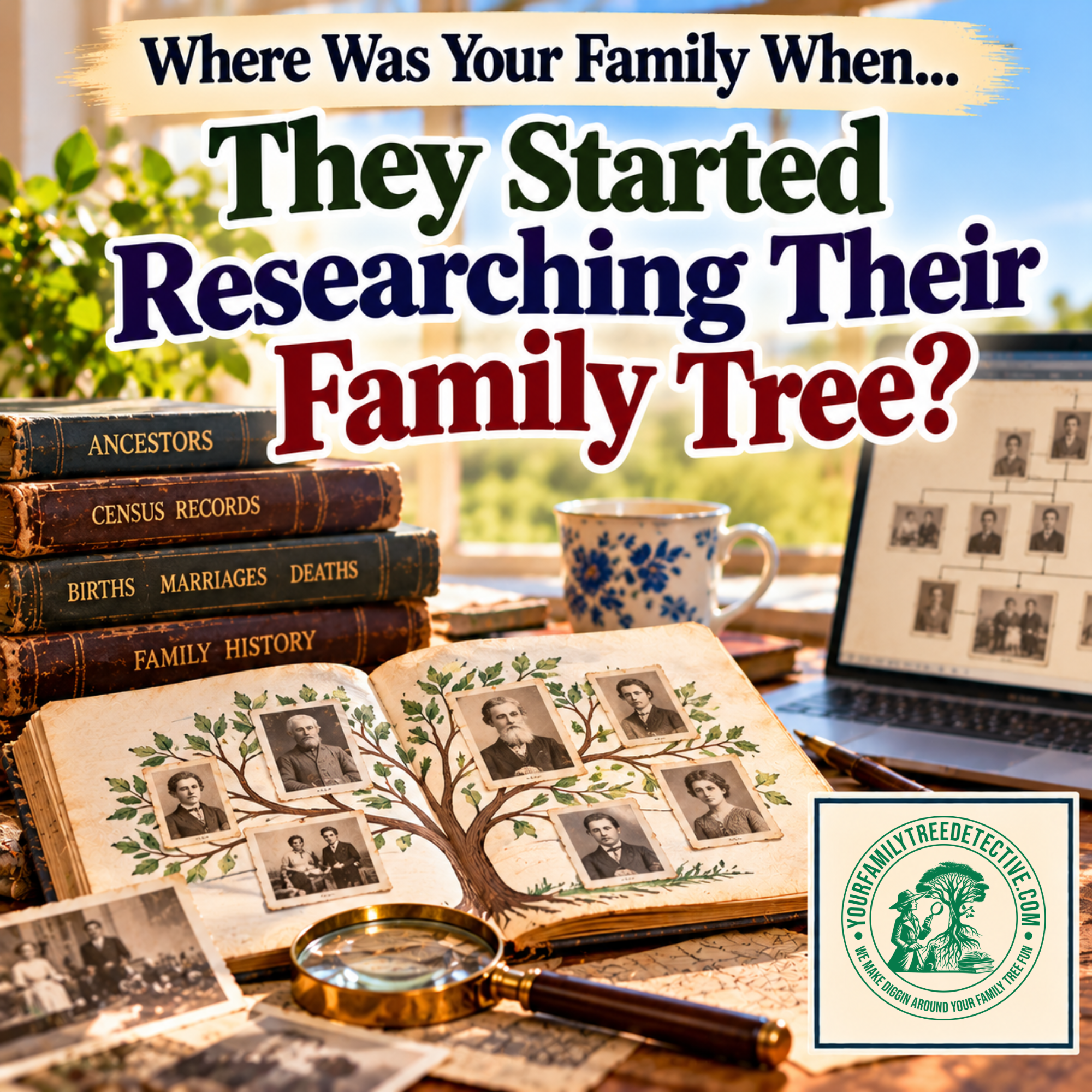
Where Was Your Family When… They Started Researching Their Family Tree
Every family tree begins with a question. Sometimes it is as simple as wondering where a grandparent was born, why the family has a particular surname, or who the unfamiliar people are in an old photograph. Other times, it begins with a family story that has been passed down for generations, leaving someone curious enough to discover whether it is actually true.
Do you know who first started researching your family tree? Was it your mother, father, grandmother, grandfather, aunt, uncle, cousin, or perhaps a distant relative you have never met? Maybe someone began collecting family information decades before computers and online genealogy databases made research so accessible.
What sparked their curiosity? Perhaps they were preparing for a family reunion, celebrating an important anniversary, tracing the origins of a family heirloom, or trying to discover where their ancestors came from. Maybe an elderly relative shared a fascinating story, a family photograph raised unexpected questions, or someone simply realised they knew very little about the generations who came before them.
For earlier generations of family historians, research could be a very different experience from what we know today. There were no online family trees, instant searches, or digital copies of millions of historical documents. Researchers wrote letters to relatives, churches, government offices, archives, and historical societies, sometimes waiting weeks or months for a reply.
Imagine travelling to a distant town to search through parish registers, census records, cemetery inscriptions, land documents, or old newspapers. Researchers spent hours examining microfilm, handwritten registers, card catalogues, and enormous volumes of records, hoping to find a single name that might lead them to the next generation.
Some family historians maintained handwritten pedigree charts, family group sheets, notebooks, and carefully organised folders. Others created enormous collections of index cards, recording births, marriages, deaths, occupations, addresses, and family relationships. Every discovery had to be documented, and every connection required careful investigation.
Then came personal computers and genealogy software. Suddenly, family historians could organise thousands of names, dates, places, and relationships without repeatedly rewriting their charts. Later, the internet transformed research again, making records from around the world accessible without leaving home.
Today, we can search digitised newspapers, census returns, immigration records, military documents, cemetery databases, and countless other historical collections. DNA testing has added another dimension, allowing researchers to discover biological connections, identify unknown relatives, and investigate family mysteries that traditional records alone could not resolve.
But even with all these developments, one of the most valuable genealogy resources remains exactly what it has always been: talking with family members.
Think about the information an older relative might have shared with the person who first researched your family tree. Perhaps they remembered their grandparents' names, the location of an old family farm, the circumstances surrounding an ancestor's immigration, or stories about relatives who had died long before you were born.
Those conversations may have preserved information that would otherwise have disappeared. A handwritten note recording a grandmother's memories could now be the only surviving account of an event that happened more than a century ago.
Have you inherited someone else's family history research? Perhaps there are boxes filled with documents, photographs, certificates, handwritten notes, family trees, newspaper clippings, and correspondence. You might even have inherited research from someone you never met, yet their curiosity and determination have helped you discover your own family story.
If you have inherited a collection, take time to examine how the original researcher worked. Look for correspondence with relatives, notes about unsuccessful searches, questions they never answered, and documents they considered important enough to preserve. Their research journey can be just as fascinating as the family history they uncovered.
Pay particular attention to the sources they used. Earlier researchers sometimes relied heavily on family stories, published genealogies, or information supplied by relatives. Those details can provide wonderful clues, but they should be checked against original records whenever possible. New discoveries may confirm their conclusions, correct an old mistake, or reveal a completely unexpected branch of the family.
And what about the mysteries they never solved? Perhaps your grandmother spent years searching for a missing ancestor, or a distant cousin could never establish where the family lived before emigrating. With today's available records and research techniques, you may finally be able to answer a question that frustrated another family historian for decades.
There is also something special about discovering that genealogy has become a tradition within the family. One generation begins collecting names and dates, another adds photographs and stories, and the next continues searching for previously unknown ancestors. Each researcher contributes another piece to a puzzle that may never be completely finished.
Sometimes the person who began the research had no idea how important their work would become. They may simply have wanted to know more about their grandparents. Years later, their notebooks, letters, and family charts could become treasured resources for descendants scattered across different countries.
And let's not forget the unexpected adventures that come with family history research. A search for one ancestor can lead to a completely different discovery. A mysterious surname might reveal an unexpected marriage. A newspaper article could uncover a family business. A DNA match may introduce relatives who never knew one another existed.
Of course, there are also the famous genealogy rabbit holes. You sit down intending to check one birth date, and several hours later you are researching an entirely different family in another country, wondering how on earth you ended up there!
For some of us, researching the family tree becomes far more than a hobby. It develops into a lifelong passion for discovering, understanding, and preserving the stories of those who came before us.
Today's Family Tree Challenge: Discover who first started researching your family tree, when they began, and what inspired them. Look for their notebooks, photographs, letters, and research records. Find out what they discovered, which mysteries they couldn't solve, and whether you can continue their work. If you're the first family historian, record your own research journey for future generations.
Let us know in the comments below about the stories you uncover.
Podcast Replay: https://youtube.com/live/391V5dadjfU?feature=share
Ready to uncover your own family story?